Are Edibles Illegal in India? What the NDPS Act Says
Article Summary
A pack of gummies brought back from a trip abroad, or a tray of festival sweets at a party, raises one plain question: are edibles illegal in India? What the NDPS Act says is clear on the main point: edibles made from the flowering tops or resin of t...
A pack of gummies brought back from a trip abroad, or a tray of festival sweets at a party, raises one plain question: are edibles illegal in India? What the NDPS Act says is clear on the main point: edibles made from the flowering tops or resin of the cannabis plant fall inside its definition of cannabis, which covers any mixture of those forms and any drink prepared from them.[1]
For the wider legal picture, the guides on the THC Store India blog cover each product type. Hemp-seed foods follow separate food rules, and whether a particular product or case is a problem turns on the plant part used, the quantity and the state's excise rules. The sections below read the answer off the statute itself.
Disclaimer: This article is for informational purposes only and does not constitute medical advice. Always consult a qualified healthcare professional before starting any new supplement or treatment. Cannabis-based products may require a prescription in India under NDPS Act regulations. Book a consultation with our panel doctors for personalized guidance.
Are edibles illegal in India? The short answer
Cannabis edibles made from flowering tops or resin are covered by central law in India, because the NDPS Act's definition of cannabis includes ganja, charas and any mixture or drink prepared from them.[1] A gummy, a brownie or a chocolate made with that material is not a separate legal category. In the eyes of the statute it is cannabis in another shape.
Section 20 of the NDPS Act, 1985 punishes producing, manufacturing, possessing, selling, purchasing, transporting or using cannabis, with penalties that depend on the quantity involved.[2] That covers almost everything a person might do with an edible: making it, buying it, carrying it, giving it to a friend or eating it.
Hemp-seed foods are a different matter. Hemp seed, hemp seed oil and hemp seed flour are permitted as food in India within set limits on THC and CBD, and they come from the seed rather than the flowering tops or resin. A seed snack and a cannabis brownie can both carry a leaf on the pack, but the law looks at them very differently.
What the statute does not do is give a verdict on a single product or a single person's situation. That depends on which part of the plant was used, how much of it is involved and the excise rules of the state where it happens. This post therefore explains the rules and does not promise that any particular product is safe to buy, carry or eat.
What counts as an edible under Indian law
Indian law has no separate category called edibles; the question is always whether a food or drink contains a form of cannabis that the NDPS Act defines.[1] The word edible is everyday language, borrowed mostly from countries where cannabis foods are sold in shops.
In ordinary use, edible covers a wide range of things:
- gummies and jelly sweets
- brownies, cookies and cakes
- chocolates and bars
- bhang drinks such as thandai, and bhang sweets such as golis or laddoos
- butters, oils and syrups used to make any of the above
For a reader in India, it helps to separate edibles into broad groups before asking whether one is allowed:
- Cannabis edibles: foods made with flowering tops, resin or extracts of them. These sit inside the narcotics law.
- Hemp-seed foods: seeds, seed oil and seed flour, which follow food rules with limits on THC and CBD.
- CBD or hemp-extract products: oils and gummies whose position depends on where the extract came from and what else it contains.
A label that says hemp, herbal, natural or Ayurvedic does not change what an ingredient is in law. A gummy made with an extract of flowering tops is still a mixture of that extract, whatever name the front of the pack uses. The only way to know which group a product belongs to is to read the ingredient list and ask the seller where each ingredient came from.
How the NDPS Act defines cannabis and its forms
The NDPS Act defines cannabis (hemp) in Section 2(iii) to include charas and ganja, and also any mixture of those forms, with or without any neutral material, or any drink prepared from them, as a court judgment reading the Act records.[1] That single sentence is why the edible question has a clear answer for products made from the flowering tops or resin.
The Act defines ganja as the flowering tops of the cannabis plant, excluding the seeds and leaves when they are not accompanied by the tops, by whatever name they are known.[1] In plain words, ganja is the flower. The seeds and leaves on their own are left out of this particular definition.
Section 2(iii)(a) of the NDPS Act, 1985 defines charas as separated resin, crude or purified, obtained from the cannabis plant, and this includes concentrated preparations and hashish oil.[1] Resin is the sticky material the plant produces on its flowers, and concentrates and oils made from it are covered as well.
Put these definitions together and the position of most edibles becomes clear:
- A brownie baked with butter infused with flowering tops is a mixture of ganja with neutral material.
- A gummy made with an oil extracted from resin or flowers is a mixture of charas or ganja.
- A drink prepared from either form is named directly in the definition.
Flour, sugar, gelatine and cocoa are the neutral material in this reading. Adding them does not take the cannabis out of the definition; the definition was written to include exactly that.
What the NDPS penalty section punishes and how penalties scale
Section 20 of the NDPS Act, 1985 punishes cultivating any cannabis plant, and producing, manufacturing, possessing, selling, purchasing, transporting or using cannabis, with penalties that depend on the quantity involved.[2] The list of acts is wide. A person does not need to be selling anything to come within it; possessing or using cannabis is enough.
Under Section 20 of the NDPS Act, 1985, an offence involving only a small quantity of cannabis can lead to rigorous imprisonment for a term which may extend to one year, or a fine which may extend to ten thousand rupees, or both.[2] This is the lowest level of penalty the section sets for cannabis.
Under Section 20 of the NDPS Act, 1985, an offence involving a commercial quantity of cannabis carries rigorous imprisonment of not less than ten years, which may extend to twenty years.[2] Between these levels sits a middle band for amounts that are more than small but less than commercial, with its own penalty.
The thresholds that mark a small quantity and a commercial quantity are set separately from the section and are not stated in this post. How a court measures the quantity in a mixed food, such as a tray of brownies or a jar of gummies, is a technical question that depends on the facts and on how courts have read the law. Nobody should assume that a sweet is safe because only a little cannabis went into it.
Everything in this section is a description of what the statute says. It is not a prediction of what would happen in any case, which depends on the evidence, the quantity, the state and the court. Anyone facing a real situation, or worried about one, should speak to a lawyer who practises criminal law in their state.
Central law and state excise law: who decides what
The central NDPS Act sets the baseline for cannabis across the country, and each state runs its own excise rules on top of it.[2] Those state rules differ, especially on bhang, on licensed shops and on how much a person may hold. This is why the same drink can be handled differently in different states.
In Manjee vs State of Rajasthan, the Rajasthan High Court held that the central NDPS Act prevails over a conflicting state excise enactment to the extent of the inconsistency, as far as cultivation of bhang is concerned.[3] The court treated the conflicting part of the state law as giving way to the central Act.
Two practical points follow for a reader trying to understand edibles:
- A state rule cannot be read as a permission that overrides the central Act where the two conflict.
- States can still add their own conditions, licences and limits, so a rule in one state tells you nothing certain about the next.
This post does not name any state as permitting any edible, and it should not be read as doing so. State rules are amended, and how they are enforced on the ground varies again.
The safest working assumption for anyone travelling is simple: the rule that matters is the rule of the state you are standing in, read together with the central Act.
Are gummies illegal? Where THC gummies stand
A gummy that contains THC from cannabis flowering tops or resin is a mixture of a defined cannabis form, so the NDPS Act's definition of cannabis and its penalty section apply to it.[1] THC, the compound in cannabis that causes a high, usually reaches a gummy through an extract or an infused oil, and those are made from the flowers or the resin. For what the letters stand for, see our explainer on the THC full form and what THC gummies are.
Gummies sold as hemp or CBD gummies need their ingredients checked rather than their name trusted. The questions that matter are:
- Which part of the plant did the extract come from: seed, leaf, or flowering tops?
- Does the label state a THC figure, and is it backed by a lab report from a named laboratory?
- Who made it, and what licence does the maker hold?
India has no THC percentage threshold of the kind some other countries use to separate hemp from cannabis. Many imported packs, and many websites, quote a foreign limit as if it applied everywhere. It does not decide anything here. A gummy is judged in India by the plant part and the form of cannabis it contains, read against the NDPS definitions, and by the food rules where it claims to be a hemp-seed product.
Gummies bought abroad deserve particular care. A pack that is sold openly in another country can still contain a form of cannabis that the Indian definition covers, and carrying it through an Indian airport puts the person, not the foreign shop, in front of Indian law.
Is bhang an edible, and does the law handle it differently?
Bhang is an edible in everyday terms, since it is eaten as a paste, mixed into sweets or drunk in thandai, and the NDPS definition of cannabis expressly mentions mixtures and drinks.[1] So bhang cannot simply be set aside as tradition.
Bhang is made mainly from the leaves of the cannabis plant, and the NDPS Act's definition of ganja excludes the seeds and leaves when they are not accompanied by the flowering tops.[1] This exclusion is why bhang is discussed separately from ganja-based edibles, and why its position depends so heavily on state excise rules, licensed shops and local practice.
Festival custom does not by itself decide the legal position. Holi and Shivratri bring bhang into public view in many places, but the rule that applies is the state's excise law and the quantity involved, read with the central Act. A government-licensed bhang shop in one town does not mean the same sweet can be carried into another state, or that a bhang-laced chocolate bar is treated the same way as a glass of thandai.
For more on bhang specifically, see whether bhang contains alcohol.
Hemp-seed foods and the food safety limits
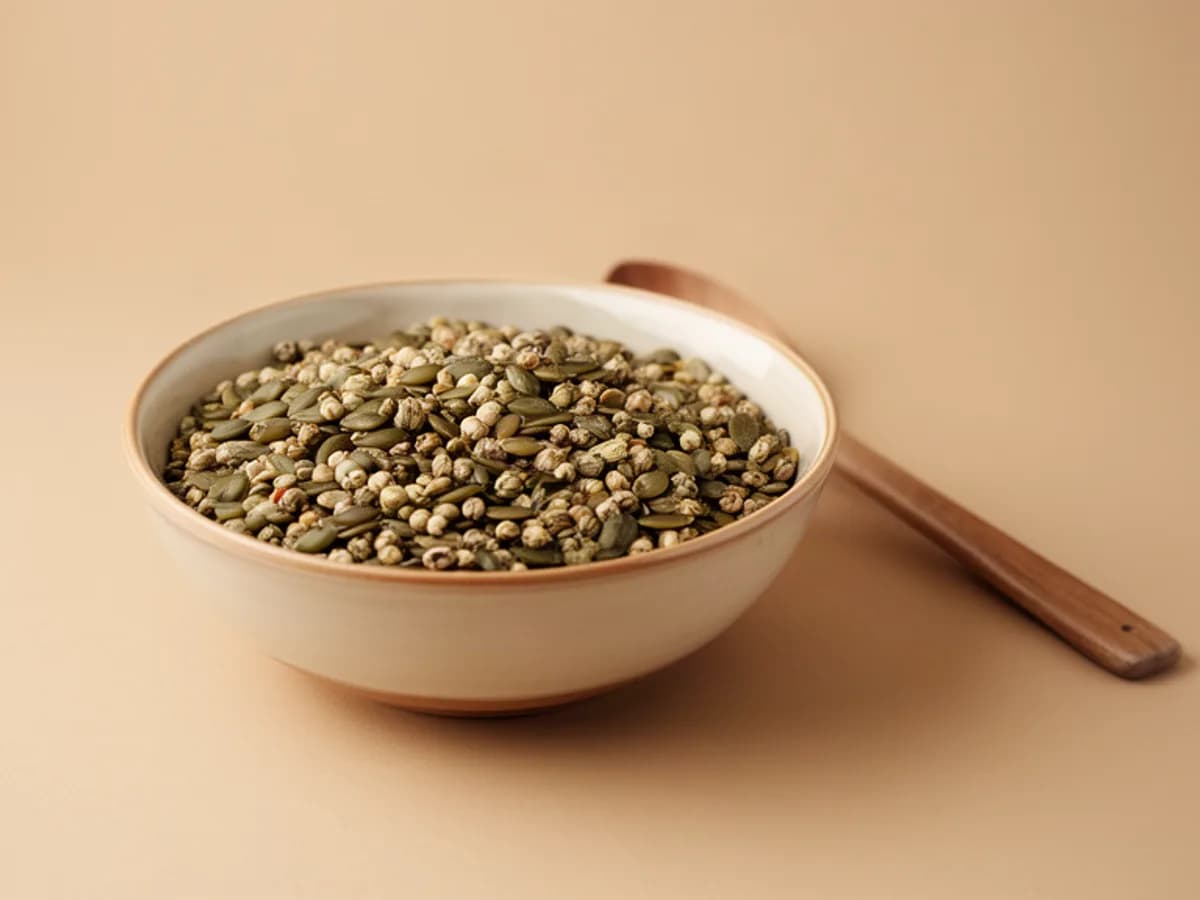
Hemp-seed foods are the one group of hemp edibles that Indian food rules permit: hemp seed, hemp seed oil and hemp seed flour, each within set upper limits on the THC and CBD it may contain. The permission covers the seed and what is made directly from it. It does not cover foods made from the flowering tops or the leaves.
This places seed snacks, flours and oils in a different position from a cannabis gummy or brownie. The seed is also excluded from the NDPS Act's definition of ganja when it is not accompanied by the flowering tops.[1]
Typical hemp-seed foods in Indian kitchens include:
- hulled seeds sprinkled on poha, upma, curd or salads
- seed flour mixed into rotis, parathas or baked goods
- cold-pressed seed oil used in dressings and chutneys rather than for high-heat frying
- protein powders made from pressed seed
You can see how such foods are packed and labelled in the hemp seeds collection and the wider hemp nutrition range. A label on these products should name the seed as the source and give the manufacturer's details and food licence number.
For more on cooking and eating them, read our guides to hemp seed uses in India and the food rules and how to eat hemp seeds in everyday meals.
Edibles compared: cannabis edibles, hemp-seed foods and CBD products
Cannabis edibles, hemp-seed foods and CBD products differ mainly in which part of the plant they come from, and that decides which rule applies. The table sets the main groups side by side.
| Type of product | Plant part used | Rule that applies | What to check on the label |
|---|---|---|---|
| Cannabis edibles (gummies, brownies, chocolates made with flower or resin) | Flowering tops, resin, or extracts of them | The NDPS Act's definition of cannabis and its penalty section[1][2] | Whether any flower or resin extract is listed; whether a THC figure appears |
| Bhang drinks and sweets | Mainly leaves | State excise rules, read with the central Act | Usually no label; ask what it contains and where it was made |
| Hemp-seed foods (seed, oil, flour) | Seed only | Food rules with limits on THC and CBD | Seed named as the source, food licence number, manufacturer's details |
| CBD or hemp-extract products (oils, gummies) | Varies: seed, leaf or other parts | Checked ingredient by ingredient | Source of the extract, THC figure, lab report from a named laboratory |
The same word, hemp, can sit in every row of this table. In everyday speech, and in the NDPS definition's own wording of cannabis (hemp), it refers to the whole plant. On a food pack it usually means the seed. On a CBD product it can mean an extract from almost any part. A reader who sees hemp on a pack has learned very little until the ingredient list says which part it came from.
The difference between seed oil and extract oil causes the most confusion, since both can be sold as hemp oil. Our explainer on how hemp oil and CBD oil differ sets out what each is made from and how to tell them apart on a label.
CBD products, oils and gummies: a separate question
CBD products, including oils and gummies, raise their own legal questions, and the answer depends on where the extract comes from and what else it contains. CBD (cannabidiol) is a compound found in the cannabis plant that does not cause a high in the way THC does. That fact alone does not settle anything, because the law looks at the plant part and the form, not only the compound.
A CBD gummy made with an extract from leaves raises different questions from one made with an extract that also carries THC from the flowering tops. A product can also contain other herbs, sweeteners or additives that bring their own rules. This is why a single verdict on CBD edibles would mislead the reader, and this post does not give one.
Two posts read the question in detail:
To see how such products are usually labelled, with the source of the extract, the manufacturer and the licence details, look at the listings in the CBD products range and the edibles and gummies shelf. A useful label on a CBD gummy states the plant part the extract came from, the amount of CBD per piece, the THC content and the name of the laboratory that tested the batch. If those details are missing, the product cannot be placed in the table above, and that uncertainty is itself the answer.
Medicinal use and prescriptions: what is different
Medicinal cannabis products sit in a separate category from a gummy or brownie sold as a snack. Classical Ayurvedic medicines that contain cannabis leaf, often called vijaya in Ayurvedic texts, are made under a state Ayurvedic manufacturing licence and are meant to be taken under medical supervision. The drug rules that govern them, rather than the penalty provisions discussed above, set that supervision requirement.
The difference is practical as well as legal. A licensed medicine has a manufacturer, a batch number, a stated composition and a defined dose, and it is meant to be used for a stated reason with a practitioner watching. A cannabis brownie bought from a stranger has none of those things.
For more on how medicines differ from recreational products, read our post on prescription THC medicine and the NDPS Act. Licensed herbal formulations, with their manufacturing details on the pack, can be seen in the Ayurvedic and herbal range.
Anyone considering a cannabis-based product for a health problem should discuss it with a qualified doctor before taking anything; you can book a consultation with a doctor to go through your situation, the medicines you already take and whether such a product makes sense at all.
What to check before you eat or carry any edible
Before you eat or carry any edible, check what it is made from, who made it and where you are taking it. Each of these can change the answer, and none of them can be guessed from the shape of the product.
- Read the full ingredient list. Look for the plant part (seed, leaf, flowering tops) and whether an extract is named. A list that says only hemp or herbal blend is incomplete.
- Look for a lab report. A report from a named laboratory, matched to the batch number on the pack, should state THC and CBD content.
- Find the manufacturer and licence. A food should carry a food licence number; a medicine should carry manufacturing licence details. A pack with no maker's name or address is a reason to leave it alone, not to guess.
- Check the THC figure. A pack that gives no THC figure at all tells you nothing about what you would be eating.
- Think about where you are going. Carrying an edible across state lines, or onto a flight, is where state rules and quantity matter most.
Edibles also act more slowly than smoking. Effects can take a long time to start, which leads some people to eat more before the first piece has worked. An edible containing THC can cause drowsiness and slower reactions, so driving, riding a two-wheeler or operating machinery after one is a separate risk, quite apart from the legal one. Keep any edible, of any kind, well away from children and pets, since gummies and chocolates look like ordinary sweets.
Common mistakes when reading the law on edibles
The most common mistake is assuming that turning cannabis into food changes its legal status, when the NDPS definition of cannabis was written to include mixtures and drinks.[1] Several other errors come up again and again:
- Treating the format as the answer. A gummy, a cookie and a chocolate are judged by what is inside them.
- Stretching festival tolerance. Open sale of bhang during a festival in one place does not cover gummies, chocolates, larger quantities or carrying it to another state.
- Reading the hemp-seed food rules as a general permission. Those rules cover seed, seed oil and seed flour within limits, not every product with hemp on the pack.
- Borrowing a foreign THC limit. India does not separate hemp from cannabis by a THC percentage the way some countries do.
- Assuming a state rule overrides the central Act. Where the two conflict, a High Court has held that the central Act prevails over the state excise enactment.[3]
- Trusting the seller's word. A seller's assurance that a product is fine carries no weight in a police station or a court.
The reliable approach is the one this post has followed: read what the statute defines, find out which part of the plant a product contains, check the state's rules, and ask a lawyer about any real situation rather than relying on a pack, a website or a friend.
Last reviewed: 26 November 2026. General information, not legal advice.
?Frequently Asked Questions
Are cannabis edibles illegal in India?
Are THC gummies illegal in India?
Is bhang legal in India?
Are hemp seed foods allowed in India?
Does the word hemp on a pack mean an edible is allowed?
What is the penalty for possessing a small quantity of cannabis?
Does the state excise law override the NDPS Act?
Sources
Share this article
Written by
THC Store Editorial
Published 1 hours ago