
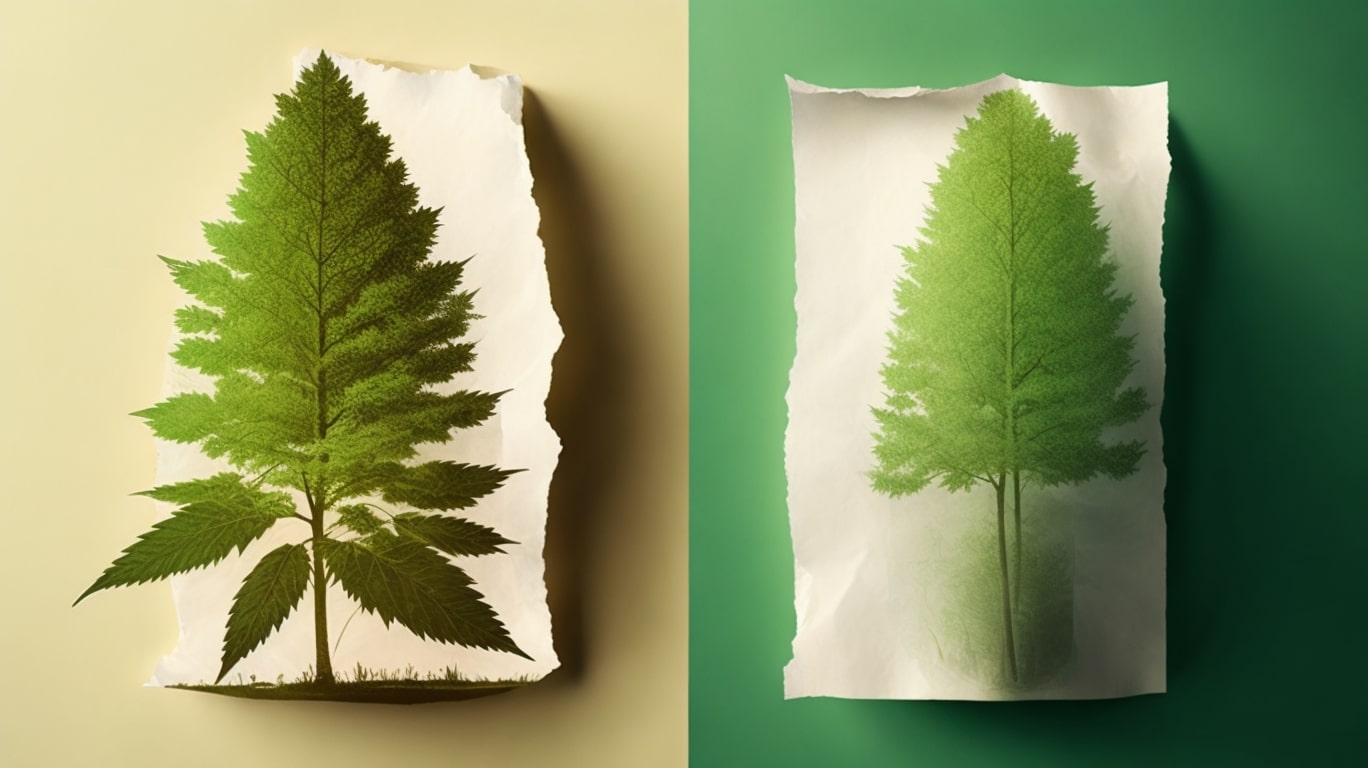
Paper Battle: Hemp vs. Trees
Article Summary
Say goodbye to traditional paper made from wood pulp and hello to sustainable hemp paper.
In today's environmentally conscious world, the choice of materials for everyday products can have a significant impact on our planet. One such choice is the source of paper, a ubiquitous material in our lives. The age-old battle between hemp and trees as sources of paper has been gaining attention in recent years, especially in India where sustainability and resource management are becoming national priorities. In this comprehensive guide, we will delve into the environmental, economic, and practical aspects of this paper battle, exploring the advantages and disadvantages of both hemp and trees as paper sources for the Indian context.

A6 Hemp Diary || Candy || 48 pages | OG Hemp
Table of Contents
- Introduction
- Hemp Paper: A Sustainable Contender
- Environmental Benefits
- Renewable Resource
- Reduced Chemical Usage
- Durability and Longevity
- Tree Paper: The Classic Choice
- Abundance
- Established Industry
- Variety
- Recycling
- The Middle Ground: Blending Hemp and Trees
- Hybrid Solutions
- Making an Informed Choice
- Consumer Awareness
- Industry Shift
- 4 Steps of Making Hemp Paper at Home
- Conclusion
- FAQs
Hemp Paper: A Sustainable Contender
1. Environmental Benefits
Hemp paper represents a fantastic eco-friendly option for paper production that's gaining traction in India's sustainability movement. It's made from the fast-growing hemp plant, which takes up significantly less agricultural land compared to trees and absorbs substantially more carbon dioxide during its growth cycle, helping combat climate change—a critical concern for India's environmental future.
Unlike traditional paper made from trees, hemp paper manufacturing doesn't require harmful bleaching chemicals, dramatically reducing environmental contamination and water pollution. Plus, it boasts exceptional strength and remarkable longevity—it doesn't turn yellow with age, and historical hemp documents have survived for over 400 years! Even more impressive, you can recycle hemp paper up to 7-8 times, compared to just 3 times for conventional tree paper.
For Indian consumers and businesses looking to reduce their environmental footprint, hemp paper presents not only an opportunity to save forests but also represents an economically sensible choice in the long run. Using hemp in paper production creates a win-win scenario for both the environment and sustainable economic development in India.
Visit the following links to learn more about the topic:
- https://www.ncbi.nlm.nih.gov/pmc/articles/PMC8819531/
- https://vicentellp.com/insights/national-hemp-month-spotlight-hemp-paper-and-plastics/
- https://axiomprint.com/blog/environmental-benefits-of-hemp-paper/

A5 Hemp Diary || Pine Leaf || 48 Pages | OG Hemp
2. Renewable Resource
Hemp stands out as an incredibly renewable resource with a vast range of applications relevant to India's diverse industries—from paper and textiles to composites, biofuel, and even the food sector. When it comes to paper production specifically, hemp presents a compelling eco-friendly alternative compared to traditional tree-based sources that have long dominated the Indian market.
The agricultural advantages are remarkable: hemp requires significantly less water than most crops—a crucial consideration for water-stressed regions across India—and needs fewer pesticides, making it a genuinely sustainable cultivation option. Unlike trees that take 20-80 years to reach harvestable maturity, hemp plants reach full growth in just three to four months. One acre of hemp can yield as much usable paper fiber as four acres of trees, making it an extraordinarily efficient land-use choice.
Major global companies like Ford Motors, Patagonia, and The Body Shop have already incorporated industrial hemp into their products, demonstrating its commercial viability. Hemp paper production is particularly environmentally conscious, generating minimal emissions during processing. For India's growing economy and commitment to sustainable development, hemp offers tremendous potential as a greener and economically viable alternative to conventional paper sources, supporting both environmental goals and rural agricultural development.
Visit the following links to learn more about the topic:
- https://www.sciencedirect.com/science/article/pii/S240584402200041X
- https://www.forbes.com/sites/ashoka/2013/05/29/industrial-hemp-a-win-win-for-the-economy-and-the-environment/?sh=552a509c289b
- https://www.linkedin.com/pulse/hemp-really-next-big-thing-sustainable-paper-shailesh-ganeriwala

Hemp Paper Hexa Bag || Set of 5 | OG Hemp
3. Reduced Chemical Usage
Hemp paper production offers significant environmental advantages over traditional wood-based paper manufacturing, particularly in terms of reduced chemical usage—a critical concern for India's water resources and ecosystem health. When we manufacture paper from hemp, the process requires substantially fewer harsh chemicals, which translates to considerably less harm to our precious water bodies and aquatic life.
Hemp cultivation itself is remarkably sustainable. As a crop, it actively supports biodiversity in agricultural landscapes and possesses exceptional carbon sequestration capabilities, capturing significant amounts of atmospheric carbon—a vital contribution to India's climate action commitments.
In contrast, traditional paper production processes can be quite harsh on our environment. Conventional pulp mills often employ chemicals that can severely harm aquatic ecosystems when released into water bodies. The good news is that the paper industry globally is working toward more eco-friendly methods to reduce its carbon footprint and environmental impact.
Beyond paper, hemp demonstrates versatility across numerous applications including textiles, bioplastics, and even hempcrete (a sustainable building material). Compared to conventional crops like cotton, hemp cultivation demands far fewer pesticides and substantially less water—making it particularly suitable for Indian agricultural conditions. Perhaps most importantly, hemp paper manufacturing does not release harmful chemicals like dioxin and chlorine into water systems, unlike many traditional paper mills. For environmentally conscious Indian consumers and businesses, choosing hemp paper represents a meaningful step toward protecting our rivers, lakes, and ecosystems.
Visit the following links to learn more about the topic:
- https://www.mdpi.com/2071-1050/15/8/6457
- https://www.azolifesciences.com/article/The-Aquatic-Toxicity-of-the-Pulp-Paper-Industry.aspx
- https://wordpress.kpu.ca/najikad93/does-hemp-paper-impact-the-environment/

300 GSM Hemp A1 White Sheet Sets | OG Hemp
4. Durability and Longevity
Hemp paper offers exceptional durability that far surpasses traditional paper made from wood pulp, making it an excellent investment for important documents and long-lasting applications. The structural superiority comes from hemp's remarkably long fibers—they're four to five times longer than wood fibers, resulting in significantly stronger paper that can withstand heavy use and time.
The production process is also considerably cleaner. Hemp paper doesn't require harsh chlorine-based bleaching chemicals; instead, simple hydrogen peroxide effectively whitens the paper without environmental harm. This means substantially less pollution and a cleaner manufacturing process—important considerations for India's environmental health.
The sustainability advantages are impressive: hemp paper can be recycled up to 8 times, while conventional tree paper typically manages only 3 recycling cycles before fiber degradation. From an agricultural perspective, hemp's rapid growth cycle—just 100 to 120 days to reach maturity—contrasts dramatically with the 20 to 80 years required for trees to become suitable for paper production.
Perhaps most remarkably, hemp paper demonstrates extraordinary longevity. It remains strong and intact for centuries without yellowing, crumbling, or degrading like traditional paper. Historical hemp documents from hundreds of years ago remain perfectly readable today. For Indian businesses, artists, and individuals seeking archival-quality paper for important records, certificates, or creative work, hemp paper represents the ultimate combination of strength, sustainability, and lasting value.
Visit the following links to learn more about the topic:
- https://www.linkedin.com/pulse/hemp-really-next-big-thing-sustainable-paper-shailesh-ganeriwala
- https://www.ncbi.nlm.nih.gov/pmc/articles/PMC8819531/
- https://world-en.gmund.com/hemp-paper/

Hemp Bookmarks || Assorted Digital || Set of 5 | OG Hemp
Tree Paper: The Classic Choice
5. Abundance
Paper remains a crucial material in our daily lives across India—from newspapers and notebooks to packaging and official documents. Traditionally, paper is manufactured from various tree species including pines, spruces, birch, eucalyptus, and others. Globally, pine trees are among the most commonly used sources for paper pulp production. The paper industry typically utilizes about 85% softwood coniferous trees (like pine and spruce), while hardwood trees with shorter cellulose fibers serve other specialized purposes.
An interesting aspect of paper manufacturing is that producers typically blend different types of wood fibers to harness the unique qualities and strengths of each pulp variety, creating paper with optimal characteristics. Additionally, recycled paper often contains a carefully balanced mix of new virgin fibers and recycled fibers, making it increasingly eco-friendly and resource-efficient.
It's important to note that modern paper companies—including those operating in India—have evolved to become far more sustainable than older practices from decades past. Responsible manufacturers now employ detailed forestry management models for sustainable tree harvesting. Many follow principles where for each tree harvested, several more are planted or allowed to naturally regenerate in its place, ensuring that paper production can function as a renewable resource when properly managed.
While trees remain the primary traditional source of paper, increasingly responsible forestry practices are helping make conventional paper a more environmentally conscious choice for Indian consumers who prefer familiar, readily available options.
Visit the following links to learn more about the topic:
- https://treejourney.com/different-trees-used-to-make-paper-most-common-types/
- https://www.aymachinery.com/news/what-kind-of-trees-are-used-to-make-paper.html
- https://www.worldatlas.com/articles/what-kind-of-tree-does-paper-come-from.html

Hemp Paper Bag || Small || Whitewave Diecut || Set of 5 | OG Hemp
6. Established Industry
The paper industry represents a long-standing and essential sector in India's economy, providing employment to millions and meeting the nation's enormous demand for paper products. Paper, one of civilization's most versatile materials, is primarily crafted from wood pulp—a renewable resource when forests are responsibly managed. The papermaking process involves several key technical stages including pulping, refining, and dilution.
Pulping is the critical first stage where manufacturers separate cellulose fibers from wood or other fiber sources like agricultural waste and recycled paper. These cellulose fibers form the structural backbone of all paper and paper products. Thanks to innovations in wood pulp processing and the development of automatic paper-making machines during the late 18th and early 19th centuries, paper transformed from a luxury item to an affordable, everyday commodity accessible to Indian consumers across all economic segments.
While the traditional paper and forest products industry continues to evolve, it's certainly not disappearing. Instead, it's adapting to contemporary demands and sustainability requirements. Globally and in India, we're witnessing growing demand for packaging materials, tissue papers, and pulp for hygiene products. Additionally, pulp is increasingly being used for textile fiber applications, creating new market opportunities.
The production of pulp and paper remains an energy-intensive, complex process involving multiple transformation stages that convert raw wood chips and chemicals into finished paper products. For India's established paper sector, balancing traditional manufacturing expertise with modern sustainability demands represents both a challenge and an opportunity for continued growth.
Visit the following links to learn more about the topic:
- https://www.pulpandpaper-technology.com/articles/pulp-and-paper-manufacturing-process-in-the-paper-industry
- https://www.sciencedirect.com/science/article/pii/S1364032122005950
- https://www.diva-portal.org/smash/get/diva2:1427921/FULLTEXT02

Hemp Product Sample Boxes | OG Hemp
7. Variety
When it comes to paper manufacturing, there's a remarkably wide array of tree species available to meet different quality requirements and end-use applications. Paper industry professionals categorize trees used for paper production into two broad groups: hardwood and softwood species, each offering distinct fiber characteristics.
Softwood trees—including pines, spruces, hemlocks, and firs—are particularly valued for general papermaking due to their long, strong cellulose fibers. These species produce paper with excellent strength properties suitable for everyday use. On the other hand, hardwood trees like poplars, birch, hickory, maple, and sweetgum prove better suited for creating higher-quality printing papers, magazines, and specialty products requiring smoother surfaces and finer textures.
The timber resources specifically cultivated or harvested for pulp production are known as pulpwood. While theoretically almost any tree species can be processed into pulp, coniferous (softwood) trees remain the preferred choice because their exceptionally long cellulose fibers result in significantly stronger paper. Commonly utilized softwood species include spruce, pine, fir, larch, and hemlock. Hardwood varieties like eucalyptus, aspen, and birch also play important roles in paper production.
Birch pulp deserves special mention—it's particularly valued for its outstanding tensile and burst strength properties, making it ideal for manufacturing lightweight coated and uncoated printing papers, as well as specialized coated silicone release papers. The unique characteristics of birch fibers create papers with exceptionally smooth surfaces and excellent ink holdout properties.
For Indian paper manufacturers and consumers, understanding these varieties helps in selecting appropriate paper types for specific applications—whether you need robust packaging paper or smooth, high-quality stationery.
Visit the following links to learn more about the topic:
- https://new.abb.com/pulp-paper/abb-in-pulp-and-paper/articles/characteristics-of-wood-and-papermaking-fibers
- https://www.paperonweb.com/gradepl.htm
- https://treejourney.com/different-trees-used-to-make-paper-most-common-types/

100 GSM Hemp A5 White Sheet Sets | OG Hemp
8. Recycling
Recycling represents a fantastic strategy to protect our environment by transforming waste materials into valuable new products—like creating fresh paper from discarded paper. It's essentially giving materials a second life! This approach forms a crucial part of what economists call a "circular economy"—a system designed to use our limited natural resources wisely and minimize waste generation.
Trees constitute an incredibly important natural resource, and we must utilize them responsibly and efficiently. Progressive approaches include designing products for disassembly and reuse, incorporating recycled paper content into new paper products, and substituting tree-based materials for environmentally harmful alternatives wherever possible.
However, building a truly sustainable paper industry extends beyond just recycling—it requires careful consideration of the entire product lifecycle from initial design through manufacturing to end-of-life disposal. By implementing thoughtful, circular design principles, we can dramatically reduce consumption of virgin natural resources and work toward a genuinely sustainable future for India and the planet.
For Indian consumers, actively participating in paper recycling programs—whether through municipal collection systems, school drives, or workplace initiatives—makes a meaningful difference. Every kilogram of paper recycled saves trees, water, energy, and reduces landfill burden. Simple actions like properly segregating paper waste, choosing recycled paper products when available, and supporting businesses committed to circular economy principles collectively create substantial environmental impact.
Let's embrace recycling and circular thinking to build a cleaner, greener India for future generations!
Visit the following links to learn more about the topic:
- https://www.howlifeunfolds.com/sustainability/papers-circular-economy-how-our-industry-makes-less-waste
- https://www.green.earth/blog/the-roots-of-a-sustainable-future-integrating-trees-into-a-circular-economy
- https://www.sciencedirect.com/science/article/pii/S0959652622022739

300 GSM Artistic Cannavas || 1 Piece | OG Hemp
The Middle Ground: Blending Hemp and Trees
9. Hybrid Solutions
Hybrid solutions are rapidly gaining popularity across industries like packaging and paper manufacturing due to their compelling combination of enhanced sustainability and maintained cost-effectiveness. One particularly promising example involves blending hemp and tree fibers to create innovative, eco-friendly paper products that strategically combine the proven durability of traditional tree fibers with hemp's exceptional environmental benefits. This hybrid technology holds potential to significantly reduce carbon emissions in tissue production and other paper manufacturing processes.
Another exciting development in sustainable packaging involves hybrid material systems where different complementary materials are intelligently combined to create lighter-weight, more easily recyclable packages. This approach substantially reduces the overall environmental impact of packaging while maintaining necessary protective properties—creating genuine win-win outcomes for both brands and environmental conservation.
Innovative companies are even reimagining traditional packaging formats with hybrid approaches. For instance, some manufacturers have developed two-shell paper bottle systems (like Ecologic's design) that dramatically reduce plastic usage compared to conventional bottles while maintaining functionality.
Hybrid solutions offer Indian businesses and consumers a practical pathway to make various industries more environmentally responsible without sacrificing quality or affordability. For retailers and manufacturers, these technologies enable creation of lightweight, potentially fully recyclable packaging solutions that meet both business objectives and environmental commitments.
In the Indian context where balancing economic development with environmental protection remains crucial, hybrid paper and packaging solutions represent smart, forward-thinking choices. They deliver tangible business value while contributing to India's sustainability goals—truly benefiting both commerce and our planet's future health.
Visit the following links to learn more about the topic:
- https://www.valmet.com/insights/articles/tissue/sustainable-cost-effective-and-high-quality-tissue-with-hybrid-technology/
- https://www.packagingtechtoday.com/featureds/hybrid-packaging-boosts-sustainability-benefits/
- https://www.jabil.com/industries/packaging-solutions/sustainable-packaging/ecologic.html
- https://www.allthingssupplychain.com/can-hybrid-packaging-improve-sustainability/

200 GSM Hemp A1 White Sheet Sets | OG Hemp
Making an Informed Choice
10. Consumer Awareness
Choosing sustainable paper options represents a crucial decision for environmentally conscious Indian consumers, businesses, and institutions. Hemp paper emerges as an outstanding alternative to traditional tree paper, offering compelling advantages that align with India's growing sustainability movement.
Hemp paper stands out primarily due to its exceptional durability—making it perfect for important documents, archival records, certificates, and long-lasting products like journals and specialty stationery. What makes it even more attractive is that its production process remains remarkably kind to the environment. Unlike conventional tree paper manufacturing, hemp paper production requires substantially less water (a critical consideration for water-stressed India), consumes less energy, and demands far fewer harmful chemicals during processing.
However, it's important to acknowledge that current regulatory frameworks and less mature processing technology infrastructure can make hemp paper somewhat more expensive than mass-produced tree paper in the Indian market. Despite this initial higher investment, the long-term environmental and durability benefits often justify the choice for sustainability-minded consumers.
For Indian consumers committed to environmental protection, making the conscious switch to hemp paper—even if gradually—represents a small individual change that contributes to significant collective environmental impact. Whether for personal stationery, business communications, creative projects, or gifting, choosing hemp paper products supports sustainable agriculture, reduces deforestation pressure, conserves water resources, and demonstrates commitment to India's green future.
Every sustainable choice matters, and hemp paper offers Indian consumers a practical, tangible way to align daily decisions with environmental values.
Visit the following links to learn more about the topic:
- https://www.linkedin.com/pulse/hemp-really-next-big-thing-sustainable-paper-shailesh-ganeriwala
- https://www.reddit.com/r/theydidthemath/comments/t4ghpa/request_is_it_environmentally_better_and_more/
- https://whistlercreative.ca/resources/8-sustainable-paper-stocks/

A5 Hemp Wiro Diary || Memphis || 40 Pages | OG Hemp
11. Industry Shift
Encouraging India's paper industry to embrace sustainability and dramatically reduce its environmental footprint represents an essential priority for the nation
?Frequently Asked Questions
What is hemp paper?
Why is hemp paper considered eco-friendly?
How long does hemp take to grow compared with trees?
Which gives more paper fibre per acre, hemp or trees?
How many times can hemp paper be recycled?
Is hemp paper more durable than tree paper?
Share this article
Written by
THC Store Team
Published 45 months ago


